 PKI Manager
Revocation and CRLs
Revoke a certificate and publish a signed revocation list that servers and clients can check.
What you can do
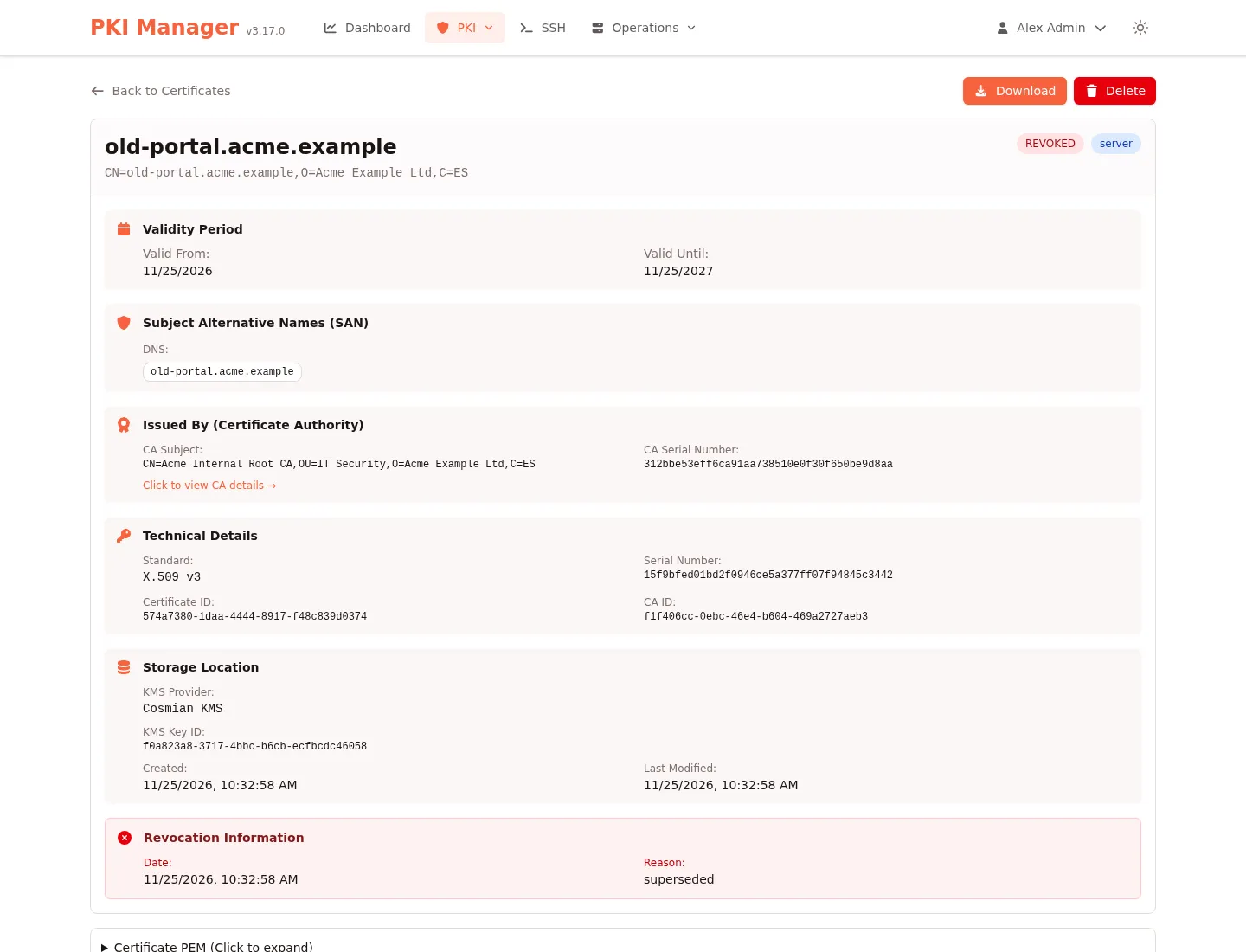
- Revoke a certificate with a standard reason, for example
keyCompromise,supersededorcessationOfOperation, and an optional note. - After each revocation, PKI Manager signs a new certificate revocation list (CRL) for that CA.
- Anyone can fetch the CRL without login:
/crl/<caId>.crl(PEM) and/crl/<caId>.der. - When the server has
CRL_DISTRIBUTION_URL, each certificate carries the address of its CRL. A client that checks revocation finds the list by itself. - A new CA has an empty CRL from the start.
How it works
The CRL lists the serial numbers of the revoked certificates of one CA, with the reason of each one. It is valid for 7 days. When a client asks for a list that is past that date, the backend signs a new one.
To sign a CRL, the backend takes the key of the CA out of the KMS, signs in memory and discards the key. The decision record explains why.
Revocation works only when the server that accepts the certificate reads the CRL. The Mosquitto guide shows the full path: revoke in PKI Manager, refresh the CRL file of the broker, and see the broker refuse the client.
What it does not do
- There is no OCSP responder. Revocation is by CRL.
- PKI Manager does not push the CRL to your servers. Each server fetches it, for example with a timer.
- SSH has its own revocation list (KRL). See SSH certificate authority.